Man’s Search for Meaning
Four weeks in four very different parts of Italy became an unexpected study of purpose: where it flourishes, where it is traded away and why we need it.
By Kieran · 7 July 2026 · 7 min read
During four weeks in Italy, I moved between a natural farm and three famous cities. Each place offered a different answer to the same question: what makes a life, or a place, feel purposeful?
On the farm, meaning came through participation. Assisi possessed a powerful inherited purpose but appeared increasingly organised around visitors. Padova still felt like a city living for its own residents. Venice remained magnificent, yet much of its daily life seemed to have been converted into an experience for outsiders.
This is not a league table of Italian destinations. It is an attempt to understand why some environments make us feel necessary while others make us spectators.
In brief
- Purpose becomes easier to feel when effort has visible consequences.
- A town can preserve its monuments while losing the ordinary life that once gave them meaning.
- Meaning often comes from being useful to something beyond the self.
Beginning on a “do-nothing” farm
I had come to central Italy because two attempts to buy land in Spain had failed. The project I imagined was not exclusively agricultural, but food, nature and community were central to it. When a friend told me about a man who had left corporate life in his forties to commit himself to natural farming, I wanted to see the experiment from inside.
The term do-nothing farming comes from the work of Japanese farmer and thinker Masanobu Fukuoka. It does not mean lying in the shade while vegetables organise themselves. The work can be strenuous. The “nothing” refers to unnecessary interference: no routine digging, weeding or fertilising simply because conventional agriculture assumes these actions must occur.
Permaculture often begins with intelligent design. Natural farming begins with humility before processes we only partly understand. Rather than asking how to impose the perfect system, it asks how little control is actually required.
The apples we did not own
One morning, several of us went to harvest the first ripe apples. The tree looked generous from a distance. Up close, the hornets and other insects had already reached most of the best fruit. Hundreds hung from the branches, but only a small number were intact enough for us to take.
My first response was economic. What a terrible return. A volunteer who had lived there much longer answered from another frame: nothing had been wasted. The tree was feeding the wider life around it, and there was still enough for us.
I did not instantly become indifferent to crops or yield. A farm must feed people. But the remark exposed an assumption I had carried into the orchard: that fruit became a loss when it did not reach a human mouth.
Natural farming was teaching less about maximising output than about negotiating our place inside a system that does not exist solely for us.
Why difficult unpaid work attracted people
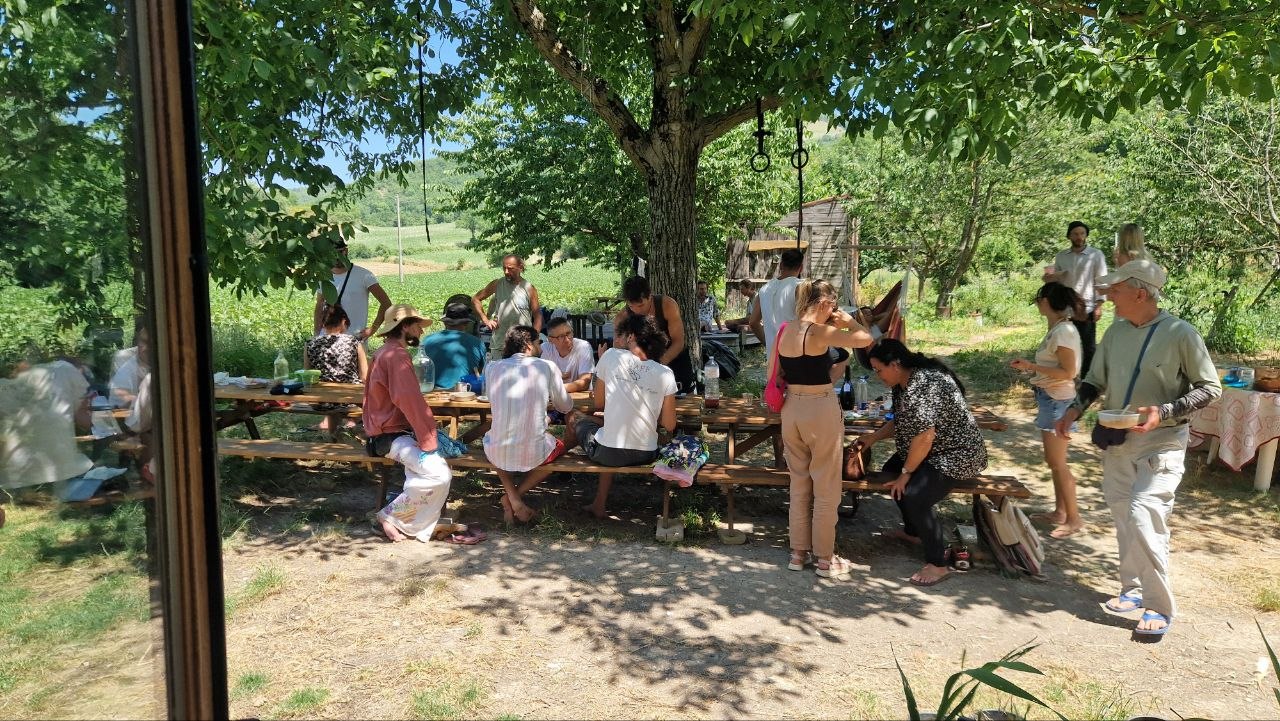
Five other volunteers were living on the farm when I arrived. They came from Italy, Germany and the Netherlands, mostly around the age of 30. Some had intended to stay for a few months and extended their time. Nobody was building a pension or receiving a salary. The accommodation was basic and the summer heat severe.
Yet their commitment did not feel like resignation. Most had already worked in restaurants, factories, construction, administration or other ordinary jobs. Those jobs produced income, but the connection between the work and its consequence had often been weak.
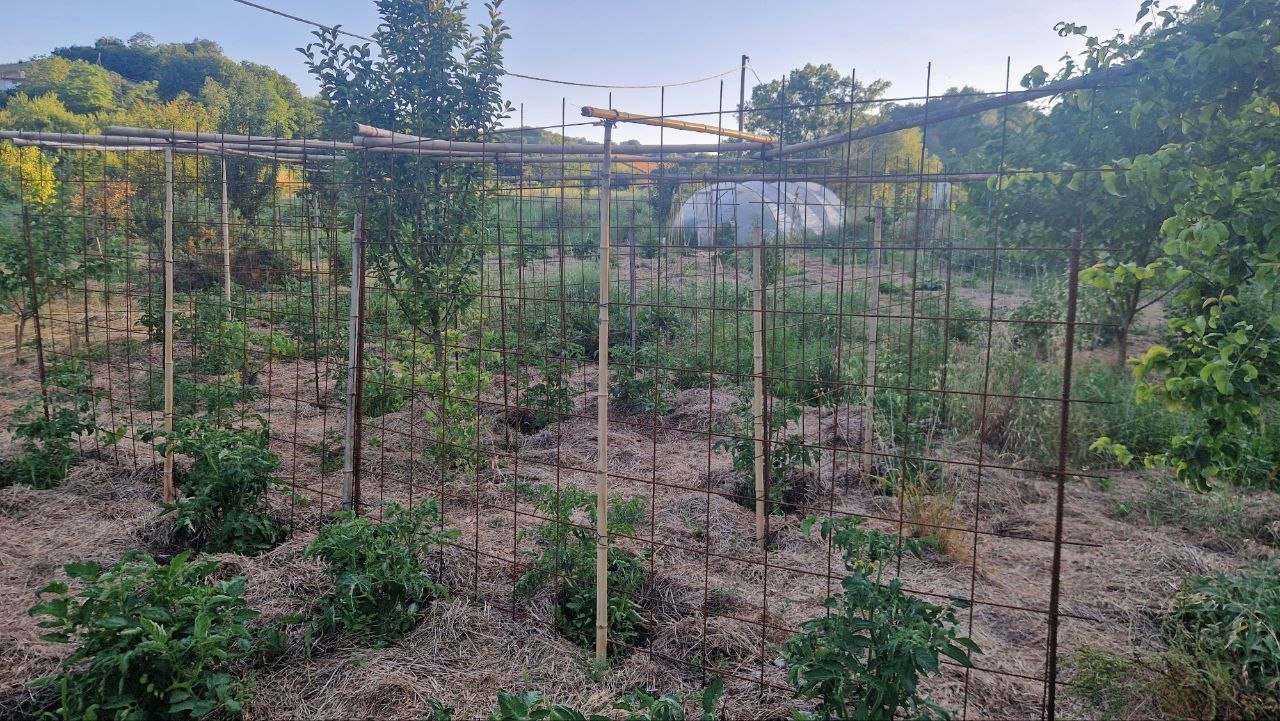
On the farm, neglect was visible. If the tomatoes were not watered, they suffered. If supports were not built, the courgettes remained cramped and less productive. Meals depended on choices made days or months earlier.
This immediacy created a kind of dignity. The volunteers were not valuable because somebody had assigned a salary to their time. They were valuable because the life of the place changed according to whether they showed up.
Purpose as nurturing life
It is tempting to romanticise physical work and dismiss the office worker’s report or email as meaningless. That would be unfair. Digital and administrative work can protect, coordinate and improve real lives. The problem is not the keyboard. It is distance.
When a person’s contribution becomes too abstract, it can be difficult to feel why the effort matters. On the farm, that distance almost disappeared. Purpose was not a slogan painted above a desk. It was the repeated act of nurturing life.
This did not answer every existential question, but it offered a powerful foundation. To be needed by a living system is one of the clearest forms of meaning we possess.
Assisi: a sacred inheritance under commercial pressure
From the farm, several of us travelled to Assisi. I had long admired St Francis and could not ignore the chance to visit his basilica. The churches carried an extraordinary spiritual force. Outside them, however, I felt a different atmosphere.
The streets were crowded with visitors, gift shops, hotels and restaurants. Businesses serving ordinary local life were much harder to find. The problem was not that pilgrims bought food or souvenirs. Sacred places have always accommodated travellers. The problem was the apparent conversion of the whole town into a product.
A friend on the farm knew a young man from Assisi who felt he could no longer build a meaningful life there. As homes shifted towards visitor accommodation and local businesses lost their resident customers, leaving became more attractive. He eventually became a shepherd elsewhere in Umbria.
The story illustrated a familiar spiral. Tourism raises demand for the visitor economy. Residents leave. Services for residents become less viable. The town then depends even more heavily on tourism.
Assisi’s purpose had not vanished. People still came to pray, and religious communities remained. Yet the civic life surrounding that spiritual inheritance appeared thinner than the buildings suggested.
Padova: a city with work still to do
My next stop was Padova, chosen partly because I wanted to visit the tomb of St Anthony, my mother’s favourite saint. The city also carries one of Europe’s great academic traditions and a large student population.
Its energy felt different immediately. Bicycles, markets, university buildings and ordinary neighbourhood life existed alongside the religious and artistic landmarks. Students and residents spoke with affection about the city, not merely pride in its tourist reputation.
Education gave Padova an active purpose. People were there to learn, teach, research, work and live. The city’s history was not only displayed; it was being continued.
The comparison with Assisi is imperfect. The cities differ in size, economy and geography. But it revealed an important distinction: a living institution continually recruits people into its purpose. A monument can preserve the memory of one.
Venice: beauty after function
I ended the journey in Venice. I had never felt a strong need to visit, but a flight from its airport made an overnight stay irresistible. Entering in the evening helped me avoid the worst crowds, and the quieter back streets were as visually extraordinary as expected.
Still, I struggled to sense what the city was now for. Venice had once been a maritime power shaped by trade, shipbuilding, exploration and exchange. Its physical form emerged from those functions. Today, much of the visible economy revolves around presenting that form to visitors.
Gondoliers competed for passengers. Restaurants and shops repeated variations of the same invitation. Residents and ordinary services seemed increasingly peripheral to the global image of Venice.
This does not mean the people who work in tourism lack dignity or that no authentic life remains. People adapt to the economy available to them. The narrower point is that a city becomes fragile when its main function is allowing outsiders to consume the evidence of its former functions.
When a place becomes somebody else’s experience
Tourism is not inherently destructive. It supports livelihoods, funds preservation and allows people to encounter beauty and history. The difficulty begins when residents mainly appear as staff inside the visitor’s experience.
A living place contains reciprocal dependence. The baker, teacher, student, farmer, mechanic and neighbour all contribute to a shared world. A destination organised almost entirely around consumption can retain beauty while weakening that exchange.
That is why the farm felt so different. Nobody arrived merely to look at the tomatoes. The place required participation. Our comfort was secondary to the life we were helping sustain.
Meaning is participation
The journey clarified that purpose is not simply a private feeling or a grand mission statement. It is often the experience of belonging to a process whose outcome is changed by our presence.
On the farm, the connection was obvious. In Padova, it was distributed through education and civic life. In Assisi and Venice, I felt the tension that arises when a place is increasingly valued for what visitors can take from it rather than what residents are building within it.
Meaning does not require everybody to become a farmer or live in a historic city. It requires some answer to the question: what is alive because I participate?
I left Italy wanting to renew my search for land, not because rural life is automatically superior, but because I had felt what happens when work, place and purpose reinforce one another. I wanted to help create one more place where people were not only entertained or accommodated, but needed.
Tagged
Italy · Natural farming · Purpose · Rural life
Share this essay