Building Something Real
A rough wooden support for tomatoes offered more satisfaction than another day of funnels, forms and digital optimisation. It was tangible, useful and real.
By Kieran · 19 June 2026 · 4 min read
One day on an Italian farm, several of us spent hours building a rough wooden frame for tomatoes and courgettes. It was not elegant. It would be useful for one growing season and then probably be dismantled. Yet I ended the day with a satisfaction I had not felt after months of digital work.
The contrast was uncomfortable. I had spent years making websites, funnels, forms and systems designed to create results later, somewhere else, for people I might never meet. This structure made no such promises. The plants needed support, we built it, and by evening the problem had visibly changed.
In brief
- Practical work makes the link between effort and consequence easy to see.
- Something does not need to be permanent or impressive to be worth doing well.
- Working with living things changes the quality of attention we bring to a task.
A modest structure with a clear purpose
Viewed from a distance, our trellis looked like the work of enthusiastic amateurs. The poles were irregular, the lines imperfect and the whole thing had none of the clean geometry of a product photograph. That did not matter. Its value was not symbolic. It had one job: to give climbing plants somewhere to go.
This directness was refreshing. In much modern work, the purpose of a task is buried under layers of abstraction. A report supports a meeting, the meeting supports a strategy, the strategy supports a target, and the target is supposed to support a life. By the time the chain reaches anything tangible, the person doing the work may no longer feel connected to it.
On the farm, failure and usefulness were close at hand. If we built badly, the plants would sag or break. If we built well enough, they would climb, fruit and feed people. There was no need for a presentation explaining our impact.
What “do-nothing” farming actually means
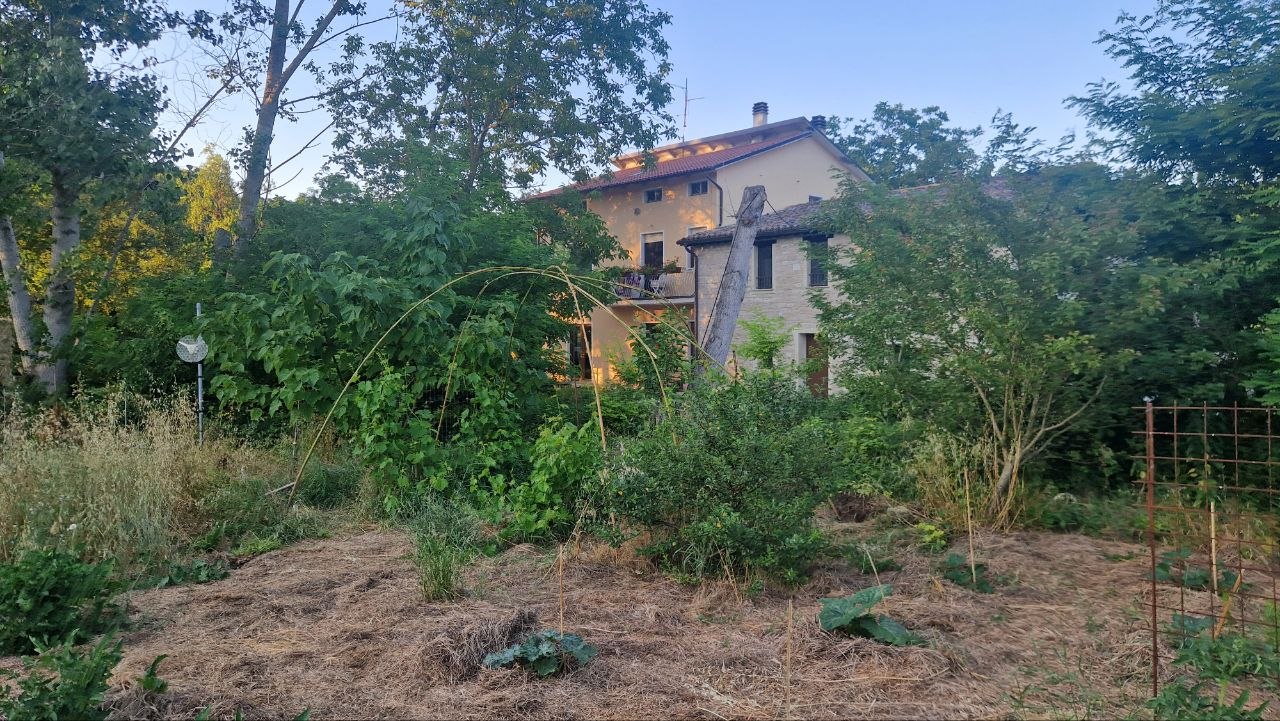
I was two days into a three-week stay on a natural farm in central Italy. The phrase do-nothing farming is misleading if taken literally. There was plenty to do, much of it tiring. The restraint lies elsewhere: do not interfere simply because intervention makes us feel competent or in control.
The approach asks the farmer to observe before acting, to work with what the land is already doing and to disturb natural systems only where necessary. For somebody accustomed to solving problems by adding plans, tools and effort, this was a different education. Sometimes the intelligent action was to wait. Sometimes it was to accept a less tidy outcome. Sometimes it was to build a support and then get out of the way.
Remembering the intelligence of the hands
I grew up in the Irish countryside, so physical work and food production were not foreign to me. What surprised me was how completely I had lost touch with the particular satisfaction of using my hands for a necessary task.
That satisfaction is not anti-intellectual and it is not a rejection of digital work. The mind also creates real things. But the body knows something that can disappear in an economy of screens: effort has weight, texture, resistance and rhythm. A piece of timber does not respond to optimism. A knot either holds or it does not.
Practical work can therefore become a form of honesty. It returns attention to the material world and makes it harder to confuse intention with result.
What the cherry tree taught me
The previous day I had picked cherries in the strongest heat of the summer so far. By late morning, my Irish skin had negotiated its surrender, but the tree continued offering fruit with an abundance that felt almost unreasonable.
I knew, of course, that fruit grows on trees. Knowing the fact is different from standing beneath branches heavy with food and recognising how little of the process depended on you. Sunlight, rain, soil, insects, roots and time had collaborated for months. My part was mostly to arrive at the right moment and receive.
That experience did not turn nature into a sentimental mother who exists to provide for us. Farms involve loss, competition, disease and difficult judgement. But it restored a sense of proportion. Human ingenuity matters, yet it operates inside a much larger intelligence that we did not design.
The satisfaction of consequence
The trellis lasted only a season, but perhaps that was part of its lesson. We often use permanence, scale and income as measures of worthwhile work. The farm offered another measure: did the task answer a real need, and were you present while doing it?
By that standard, the day was a success. We had not built a brand or optimised a process. We had helped a few plants grow towards the light. It was small, temporary and real.
Tagged
Italy · Natural farming · Purpose · Simple living
Share this essay